Imagine you have a contract in Spanish. You hire a brilliant translator—someone with a PhD in literature—who translates it into beautiful, flowing English. It captures every nuance, every emotional undertone, and reads like poetry.
You take this masterpiece to court for an immigration hearing. The judge takes one look at it and rejects it immediately.
Why? Because while it was a good translation, it wasn't a legal one. In the world of official documentation, style doesn't matter. Provenance does.
The Danger of a DIY Translation
We often hear clients ask, "My cousin is fluent in French. Can't they just translate my birth certificate for the visa application?"
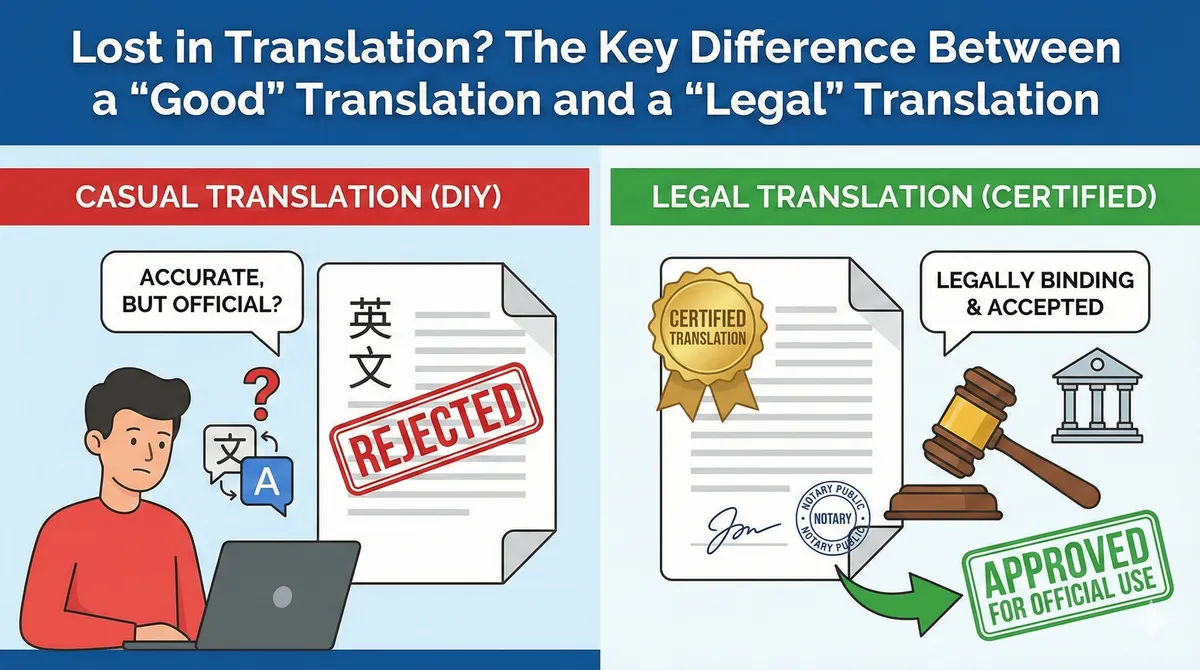
The answer is almost always no. Even if your cousin's translation is 100% accurate linguistically, it fails the primary test of administrative law: Independence.
Government bodies like USCIS (United States Citizenship and Immigration Services) or foreign courts require that the translator be a disinterested third party. A translation done by yourself, a family member, or anyone with a stake in the outcome is inherently suspect and will typically be rejected to prevent fraud.
The Anatomy of a Legally Accepted Translation
So, what turns a regular document into a legally binding one? It's not just the words on the page; it's the wrapper they come in. A Certified Translation must include specific components to be valid:
- Verbatim Accuracy: Unlike literary translation, legal translation must be word-for-word. If the original birth certificate has a smudge or a stamp that is illegible, the translation must say "[Illegible Stamp]" rather than guessing what it says.
- The Certificate of Accuracy: This is the most critical part. It is a signed statement (often notarized) from the translator or agency declaring that they are competent in both languages and that the translation is a true and accurate representation of the original.
- Formatting Matching: A legal translation should visually mimic the original. If the source text has a seal in the bottom right corner, the translation should indicate a seal in the bottom right corner. This helps officials compare the two documents side-by-side.
When "Good Enough" Costs You Everything
Using a non-certified translation for official business is like trying to pay for groceries with Monopoly money. It looks similar, but it holds no value.
We have seen clients lose thousands of dollars in non-refundable visa application fees simply because they tried to save $50 on a translation. The rejection of a document doesn't just mean resubmitting a paper; it often sends you to the back of the line, delaying work permits, university start dates, or family reunifications by months.
Frequently Asked Questions
1. Does a Certified Translation need to be notarized?
Often, yes. While USCIS technically does not require the translator's signature to be notarized (only signed), many other institutions—especially foreign governments, courts, and the DMV—strictly require the Certification of Accuracy to be notarized to prove the identity of the signer.
2. Can you translate a document if I just send a photo from my phone?
Yes, provided the photo is high-resolution, completely legible, and captures the entire document (including edges). However, we always recommend scanning documents for the best results to ensure no text is obscured by shadows or blur.
3. What if the original document has an error (like a misspelled name)?
A certified translator cannot fix errors in the source text. If your birth certificate spells your name "Jhon" instead of "John," the translation must also say "Jhon." We are ethically bound to translate what is actually there, not what should be there. You would need to get the original document corrected by the issuing authority first.
Don't risk your application on a translation that "looks fine." Contact Nexion Notary Group today for certified, court-ready translations that are guaranteed to be accepted.