When preparing documents for international use, one of the most common questions we hear is: "Do I need an apostille or legalization?" While both processes authenticate documents for foreign use, they serve different purposes and apply to different situations. Understanding the distinction is crucial to ensuring your documents are accepted abroad without delays or rejections.
🌐 What is an Apostille?
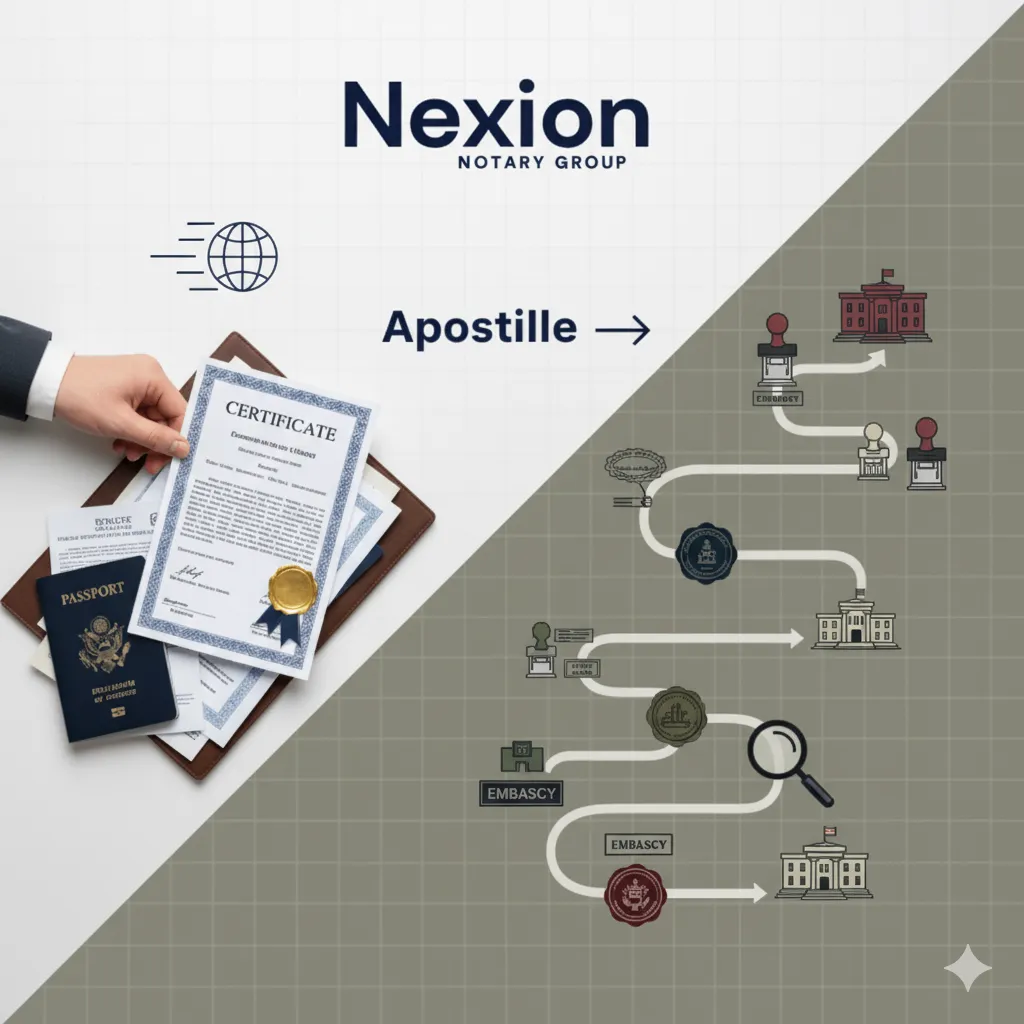
An apostille is a simplified form of document authentication created by the 1961 Hague Convention. It's a single certificate attached to your document that verifies the authenticity of the signature, seal, or stamp of the public official who signed it.
The beauty of an apostille is its simplicity and universal acceptance. Once a document has been apostilled, it is automatically recognized in all 126+ countries that are members of the Hague Convention—no additional steps required!
Key Features of Apostilles:
- Single-Step Process: One certificate does it all
- Standardized Format: Same format recognized worldwide
- Faster Processing: Typically completed in days, not weeks
- Cost-Effective: Generally less expensive than full legalization
- Wide Acceptance: Valid in 126+ Hague Convention member countries
📋 What is Legalization?
Legalization (also called authentication or chain certification) is a more complex, multi-step process required for documents destined for countries that are not members of the Hague Convention. This traditional method involves multiple levels of certification to verify the authenticity of your documents.
The Legalization Process Typically Involves:
- Notarization: Document must be notarized by a commissioned notary public
- County Certification: County clerk verifies the notary's signature
- State Authentication: Secretary of State certifies the county clerk's signature
- Federal Authentication: U.S. Department of State authenticates the state certification
- Embassy Legalization: The destination country's embassy or consulate provides final certification
As you can see, legalization is a much more involved process that can take several weeks or even months to complete, depending on the country and document type.
🔍 Key Differences at a Glance
Apostille:
- For Hague Convention member countries
- Single certificate process
- Faster (typically 1-5 business days)
- More affordable
- Standardized international format
Legalization:
- For non-Hague Convention countries
- Multi-step chain certification
- Slower (can take weeks or months)
- More expensive due to multiple fees
- Varies by destination country requirements
🗺️ How to Determine Which Process You Need
The determining factor is simple: Is your destination country a member of the Hague Apostille Convention?
Countries Requiring Apostilles (Hague Members):
Most major countries are Hague Convention members, including:
- All European Union countries
- United Kingdom, Australia, New Zealand
- Mexico, Argentina, Brazil, Colombia
- Japan, South Korea, India, China (Hong Kong & Macau only)
- South Africa, Israel, Turkey
Countries Requiring Legalization (Non-Hague Members):
Notable countries that require full legalization include:
- United Arab Emirates (UAE)
- Saudi Arabia, Qatar, Kuwait
- Egypt, Jordan, Lebanon
- Vietnam, Thailand, Malaysia
- Canada (for certain provinces and document types)
Note: This list is not exhaustive. Always verify the current status of your destination country, as new countries join the Hague Convention regularly.
💡 Common Scenarios and Solutions
Scenario 1: Moving to Spain for Work
Solution: Spain is a Hague Convention member. You'll need an apostille for your employment documents, educational credentials, and background checks.
Scenario 2: Business Expansion to UAE
Solution: The UAE is not a Hague member. Your corporate documents will require full legalization through the UAE embassy or consulate.
Scenario 3: Studying in the UK
Solution: The UK is a Hague Convention member. Your academic transcripts and diplomas need an apostille.
Scenario 4: Marriage in Egypt
Solution: Egypt requires legalization. Your birth certificate and other personal documents must go through the complete chain certification process, including Egyptian consulate legalization.
⚠️ Important Considerations
Document Type Matters
Not all documents can receive an apostille or legalization. Generally, only public documents qualify—those issued by government authorities or notarized by commissioned notaries. Private documents like personal letters or unsigned contracts typically cannot be authenticated.
Translation Requirements
Many countries require documents to be translated into their official language. The translation itself often needs to be notarized and then apostilled or legalized. Always check the specific requirements of your destination country.
Timing is Critical
If you need legalization, start the process early! The multi-step process means it can take 4-8 weeks or longer, especially if embassy appointments are required. Apostilles are much faster, typically completed within 1-5 business days.
🚀 How Nexion Notary Group Can Help
Navigating the complexities of apostilles and legalization can be overwhelming. That's where we come in! At Nexion Notary Group, we specialize in both processes and can:
- Determine the Right Process: We'll verify whether your destination country requires an apostille or legalization
- Handle All Steps: From initial notarization to final embassy certification, we manage the entire process
- Expedite When Needed: We offer rush services for urgent document needs
- Ensure Accuracy: Our expertise minimizes errors and rejections, saving you time and money
- Provide Guidance: We'll advise on translation requirements and any additional certifications needed
📞 Ready to Get Started?
Don't let document authentication stand between you and your international goals. Whether you need a simple apostille or complex legalization, our experienced team is here to guide you through every step of the process.
Contact Nexion Notary Group today at (224) 442-9606 or visit our Get Started page to begin your document authentication journey. We'll ensure your documents are properly certified and accepted wherever your path takes you!
❓ Frequently Asked Questions
Can a document have both an apostille and legalization?
Answer: No. A document receives either an apostille OR legalization, never both. The choice depends solely on whether the destination country is a Hague Convention member.
What if I'm not sure if my country is a Hague member?
Answer: Contact us! We maintain up-to-date information on all Hague Convention member countries and can quickly determine which process your documents require.
Can I do legalization myself?
Answer: While it's possible, the multi-step process is complex and time-consuming. Most people find it more efficient and reliable to use a professional service like ours to avoid costly mistakes and delays.
How long are apostilles and legalizations valid?
Answer: The apostille or legalization certificate itself doesn't expire. However, the underlying document may have validity requirements set by the receiving institution or country. For example, background checks are often only accepted if issued within the last 6 months.